What the collodion sees, and what Beato and Carnell did about it
I made two tintypes of tattoo artists recently, on separate days, and both gave me the same problem: tattoos that looked strong and solid in front of the camera came back weak on the plate.
Sitter one. His sleeves and chest piece were dense and easy to read when he was standing in front of me. On the tintype, much of that detail had simply slipped away. The tattoo was still there, but it had become pale and indistinct. You could see the pattern without really being able to read it.

Sitter One - Tattoo Tintype
Sitter two. Her shoulder and upper arm were much more successful. The darker areas of the tattoo stayed dark enough to retain their shape, and the design remained recognizable on the plate.
Putting the two plates side by side made the difference obvious. The tattoos looked very different under the studio lights than they did after the chemistry had its say.

Sitter 2 - Tattoo Tintype
Why it happens
Wet collodion doesn't see the world the way our eyes do. The plate is heavily sensitive to blue and ultraviolet and essentially blind to red. That's why a blue sky can disappear into white while a red object can go surprisingly dark.
Tattoo ink is sitting underneath the surface of the skin, in the subcutaneous layers of the dermis. The light has to travel through that skin before it ever gets to the ink — and then back out again.
So something that looks dark and substantial to me can present a very different problem to the plate. The tattoo isn't simply a black drawing sitting on top of a white background. It's colored material buried inside another colored material, and collodion is trying to sort the two apart with a very limited view of the spectrum.
Sometimes it just can't.
The tattoo and the surrounding skin start moving toward the same value, and the design loses its separation. That's why the plate can give me a strange result: the hair is black, the eyebrows are black, the beard is black — and the tattoo, which looked almost black in front of me, has nearly vanished.
The old plates
This isn't a problem I discovered. The photographers working with collodion in the nineteenth century were fighting the same chemistry. They just didn't have the luxury of knowing exactly what the plate was going to do.
Two photographers I keep coming back to approached the problem in very different ways.
Felice Beato — Yokohama
Felice Beato was photographing in Japan in the 1860s, working with wet-collodion negatives and making albumen prints from them. Among his subjects were Japanese bettō — horse grooms whose elaborate tattoos covered much of their bodies.
The photographs are extraordinary. But then you look closely at the prints and something strange happens. The tattoos are suddenly turquoise and pink. Bright turquoise.
That isn't what healed irezumi looked like on the men standing in front of Beato's camera. The tattoos were largely black, with red and other pigments. The color we see in many surviving prints was added later by hand.
We tend to look at the hand-coloring on nineteenth-century Japanese photographs as decoration — as something added to make an exotic image more attractive to a foreign customer. But with a tattoo, the color is doing something else too.
It is putting the tattoo back.

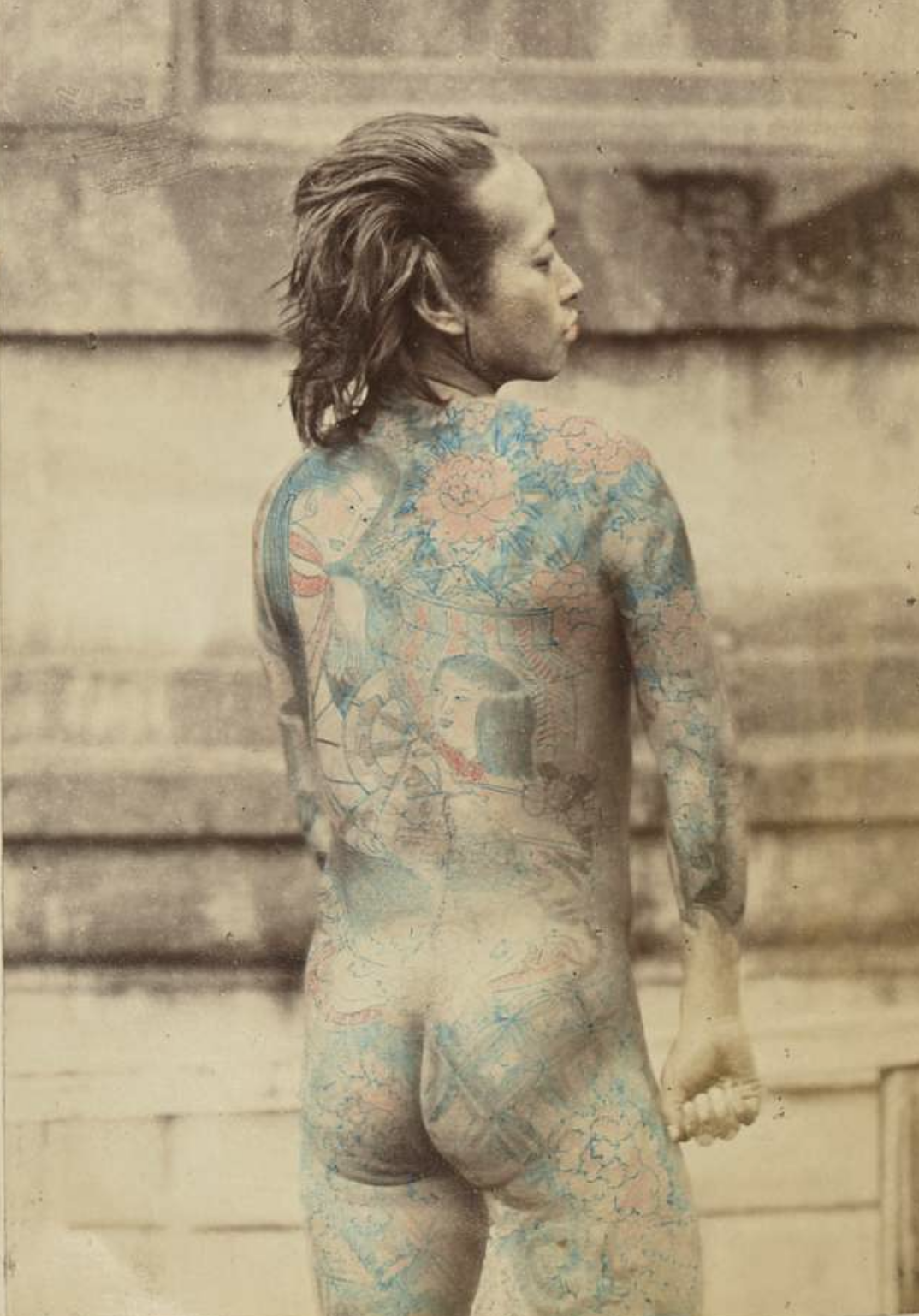

Hand Colored Albumen Prints made from Wet Plate Collodion Negatives by Felice Beato in the 1860s
The collodion negative had difficulty separating the ink from the skin. The albumen print inherited that problem also. So the colorist could simply paint the information back into the picture.
Look at the photograph and you see the tattoo. Take the color away and, in some cases, there is remarkably little left.
That changed the way I look at these photographs. The color isn't necessarily telling me what the plate saw. It may be telling me what the photographer, studio or colorist wanted me to see.
That doesn't make the photographs less interesting. It makes the history more interesting.
Samuel Carnell — Napier
Then there is Samuel Carnell, working half a world away in Napier, New Zealand. Carnell was an Englishman who came to New Zealand and became one of the important photographers recording Māori people in Hawke's Bay.
In 1880 he photographed a woman identified in the Alexander Turnbull Library's records simply as Mary. She is wearing a korowai, and across her face is moko. The negative is a quarter-plate wet-collodion glass negative.
But there is one detail in the plate grabbed my attention: her moko was accentuated with greasepaint before the photograph was made.
Beato's studio put the tattoo back into the print. Carnell put it onto the sitter before the exposure.
I understand why he did it. If the markings disappear on the plate, the photograph fails to record the thing that makes the portrait historically important.
But I also have to stop there for a moment.
Moko isn't just decoration. It carries identity, ancestry and whakapapa. Carnell was working in a colonial setting, making photographs that entered a commercial photographic world, and the image belongs to a person and a culture that existed long before the camera arrived.

Mary, a Maori woman from the Hawkes Bay district. Carnell, Samuel 1832-1920 :Maori portrait negatives. Ref: 1/4-022128-G. Alexander Turnbull Library, Wellington, New Zealand
Blind to Red
That's the part of wet plate I keep coming back to. I can see the tattoo. I can understand the tattoo. I can light it and expose it, but none of that guarantees the plate will see it the same way I do.
Beato found a way around the problem by putting color back into the print. Carnell altered the sitter before the exposure. I'm dealing with the same problem more than a century later, except now I know what the chemistry can do.
The plate doesn't simply record what is in front of the camera. It translates it through light, glass, silver and chemistry — and some things survive that translation better than others.
With tattoos, that can be frustrating. But it's also part of what makes wet plate interesting. The plate doesn't give me the tattoo I saw.
It gives me the tattoo the chemistry saw.
If you're tattooed and curious what a hundred-and-seventy-year-old process makes of your ink, come sit for one. I shoot wet plate tintypes at Handmade Images in Lambertville, New Jersey — real plates, poured, exposed and developed while you wait, and you leave with the object itself, not a file. Some tattoos hold beautifully. Some nearly vanish. Neither of us knows which until the plate comes out of the fixer, and that's most of the appeal.
28 North Union Street, 2nd Floor, Lambertville, NJ · 609.845.4811
