Wet Plate Collodion Tintype Portraits in Lambertville, NJ
There is no other photograph like this. Not "very few." None.
Every wet plate collodion portrait I make in my Lambertville studio is a single, one-of-a-kind object — hand-poured, exposed in an antique camera, and developed in front of you while you watch the image rise out of the silver. There is one plate, and it is yours.
If you've only ever been photographed with a phone or a digital camera, this is a different thing entirely. Here's what it is, and what it's like to sit for one.
What wet plate collodion Tintype actually is
Wet plate collodion is the photographic process that defined the second half of the 1800s. It was introduced in the 1850s and, for decades, it was simply how portraits were made — the faces you've seen from the Civil War era - Matthew Brady, the frontier plates made by William Henry Jackson, Watkins, Timmothy O’Sullivan, and the early industrial age were captured this way.
The short version is: I coat a plate — made of glass or blackened metal — with a syrupy solution called collodion, sensitize it in a silver bath, and expose it in the camera while it's still wet. Then I develop and fix it by hand, right away, before the plate dries. The whole thing has to happen in a matter of minutes, which is exactly why the results feel alive. You're not capturing a moment through a screen. You're capturing the moment by making a physical object out of light and silver.
I've been working in collodion for fourteen years, out of twenty behind a camera, in both wet plate and dry plate. It takes a lot of patience and skills that are not picked up over night but take years to develop. I am comfortable with this medium so remakes are rare. That matters, because it means your sitting is calm and unhurried. It’s the smallest of details that make the difference when working in this medium.
Why the portrait is unlike anything digital
A few things make a collodion portrait fundamentally different from a modern photograph:
It's a real object, not a file in the cloud or buried on your phone never to be seen again. You leave with the actual original plate I have made by hand — the same piece of metal or glass that was in the camera when the light hit it. Nothing is printed later or copied.
It's made of silver, so it lasts. A digital print is dye on paper. A collodion plate is a metallic silver image. Cared for, these outlive the people in them by generations. This is an heirloom in the literal sense — the thing your great-grandchildren could hold.
There's no editing, and no hiding. The world gets translated out of color and into pure tone. The camera sees skin, texture, and light the way no phone ever will. It's honest, and that honesty is exactly what people fall in love with.
It's one sitting, for one plate. No burst of a thousand frames to pick through. We make the picture together, on purpose.
What a sitting is like
You come to the studio at 28 N Union Street, on the second floor, in the heart of Lambertville. We talk. I explain what's about to happen so nothing feels mysterious or rushed. I share a quick history around the process, show you the camera and lenses we can take your portrait with. We discuss how you might like your portrait and look at ideas you have for it. After this I work behind the camera, framing and looking at the details. Once we are happy its time to make the film. I disappear into the darkroom for a few minutes to pour and sensitize your plate — and when I come back, we make the portrait. Wet Plate Collodion Tintype is not very sensitive to light. In fact measured in ISO (for the photographers out there) its sisitivity is about 3 ISO when fresh. As a photographer that leaves me with two choices - More light or a longer exposure. Indoors I choose more light. This means the exposure is in an instant; you'll won’t have to hold still the way people did a century and a half ago. This allows use to create crisp portraits indoors.
The best part comes next. After developing the plate in the darkroom we then fix the plate out in the daylight right in front of you, and you watch your own image appear — first a ghost, then a face, then you. People gasp. It doesn't get old for me either.
I dry the plate and varnish it using a civil war recipe made with Gum Sandarac- a tree sap from North Africa. After this you are able to take the plate home with you. 30 mins from start to finish.
Worth the trip
Lambertville sits right on the Delaware, and a lot of the people who sit for me come from a little further out — it's a short drive from Philadelphia and an easy day trip from New York City, with the portrait as the keepsake you take home from the day. Pair it with the river, the shops, and the galleries and you've got a genuinely good day out with something permanent to show for it.
Sit for a plate
Whether it's for yourself, a couple, an engagement, an anniversary, or simply because you want one honest photograph of who you are right now — I'd love to make it with you.
One sitting. One plate. Nothing like it.
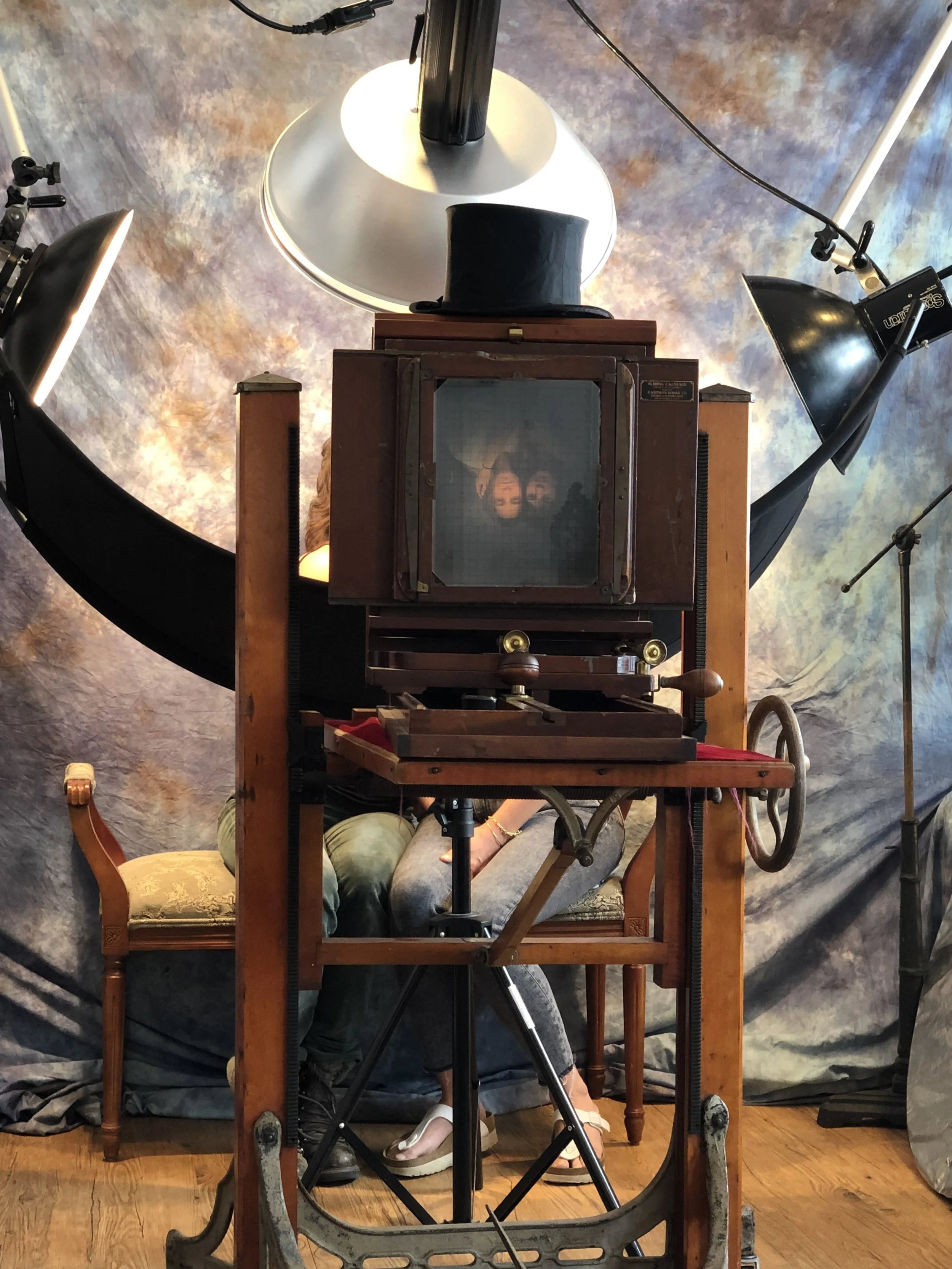
Wet Plate Collodion Tintype Sitting
