The Curious History of the Criminal Mugshot
From nineteenth-century rogues’ galleries to the wet-plate tintype.
There’s an old jail about twenty minutes from my studio, in Flemington, New Jersey. It’s attached to the historic courthouse where Bruno Richard Hauptmann was tried for the Lindbergh baby kidnapping in 1935. The trial brought newspaper reporters and photographers from all over the country. I’ve been through the jail with the director, including the old cells, and I’m planning to return next year to make some photographs there.
It’s a fascinating place, and it got me thinking about something I’ve been interested in for a while. The mugshot. More specifically, who decided that a criminal needed to be photographed twice? Once looking straight at the camera and once in profile. It seems perfectly normal to us now, but somebody had to come up with the idea.
As it turns out, the story goes back much further than you might think.
Photography and the Criminal
Some of the earliest surviving prisoner photographs were made in Belgium in 1843 and 1844. These were daguerreotypes, unique photographic images made on silver-coated copper plates, years before the wet-plate collodion process existed.
By the middle of the nineteenth century, police departments were beginning to build collections of photographs of known criminals. These collections became known as rogues’ galleries, and they must have seemed like a remarkable improvement over the methods previously available.
Before photography, the police largely relied on written descriptions, drawings and the memories of witnesses. A description of a man with brown hair, a moustache and a medium build wasn’t exactly going to narrow things down. A photograph offered something much more useful, particularly when trying to identify someone who had been arrested before.
There was a problem, however. Nobody had established a consistent way to photograph prisoners. Some were photographed sitting down, others standing up. Backgrounds, lighting and poses varied considerably. Photographers often approached the work much as they would an ordinary studio portrait.
As these collections grew, they became increasingly difficult to manage. A police department might have thousands of photographs, but finding the particular face you were looking for was another matter entirely.
It would take a Parisian records clerk to bring some order to the whole business.
A Parisian Clerk with a Problem
In 1879, a young Frenchman named Alphonse Bertillon went to work for the Paris police as a records clerk. He inherited a rather disorganized collection of criminal records and became convinced there had to be a better method of identifying repeat offenders.
Bertillon developed a system combining photographs with detailed physical measurements. He measured heads, arms, feet and various other parts of the body, believing that the combination of these measurements could reliably distinguish one person from another.
But it’s the photographic part of his work that interests me.
Bertillon realized that if you wanted to compare photographs of people, you needed to photograph everybody in exactly the same way. He developed a standardized arrangement of two views, one directly facing the camera and the other in profile. The position of the sitter, the camera distance, the lighting and the background were all carefully controlled.
The Paris police adopted his identification system in 1883, and over the following years he continued refining the photographic standards. Police departments in Europe and America eventually adopted similar procedures, establishing the familiar two-view mugshot we still recognize today.
One detail I particularly like is his fascination with ears. Bertillon believed the ear was an excellent identifying feature. The folds, the shape of the lobe and the way it joined the head were all characteristics that might distinguish one person from another, even if they grew a beard, changed their hairstyle or put on a few pounds.
Which explains why that profile photograph was so important.
Bertillon insisted on bareheaded portraits, with no distracting backgrounds or flattering lighting. The purpose wasn’t to produce a handsome likeness. It was to create a reliable record that could be compared with thousands of others.
His system of body measurements eventually fell out of favor as fingerprint identification became more practical and reliable. But the photographs stayed. More than a century later, we’re still photographing people from the front and side.
The Wet-Plate Connection
Now this is the part that interests me most.
In 1851, Frederick Scott Archer introduced the wet-plate collodion process, and for the next several decades it became one of the principal methods of professional photography. It was used to make an enormous number of nineteenth-century portraits, landscapes and documentary photographs, including much of the photographic record of the American Civil War.
And it was also part of the early history of police photography.
A photographer would pour collodion onto a glass plate, sensitize it in a silver nitrate bath, place it in the camera, make the exposure and develop it before the plate dried. It sounds straightforward when you write it down, but there’s considerably more involved. I know because this is exactly how I make photographs today.
Early police photographers could use these glass negatives to produce multiple paper prints, which could then be filed, copied and circulated to other departments. The same collodion chemistry was also used to produce tintypes, photographs made directly onto thin sheets of blackened, or japanned, iron.
So although the old police albums generally contained paper photographs, the photographic process behind many of them was remarkably similar to what happens in my darkroom.
I find that connection fascinating. Somewhere in the 1860s, a photographer may have been coating a glass plate to photograph a man accused of stealing a horse. More than 160 years later, I’m standing in Lambertville doing essentially the same thing, although the horse thief is considerably less likely to be genuine.
There’s another interesting coincidence here. By the time Bertillon’s photographic system was becoming established in the 1880s, wet-plate collodion was already being displaced by gelatin dry plates. These could be prepared in advance, stored and developed later, eliminating much of the inconvenience of working with wet collodion. Photographers must have been delighted.
The familiar mugshot was taking shape just as the chemistry behind much of early police photography was being replaced.
A Portrait You Didn’t Ask For
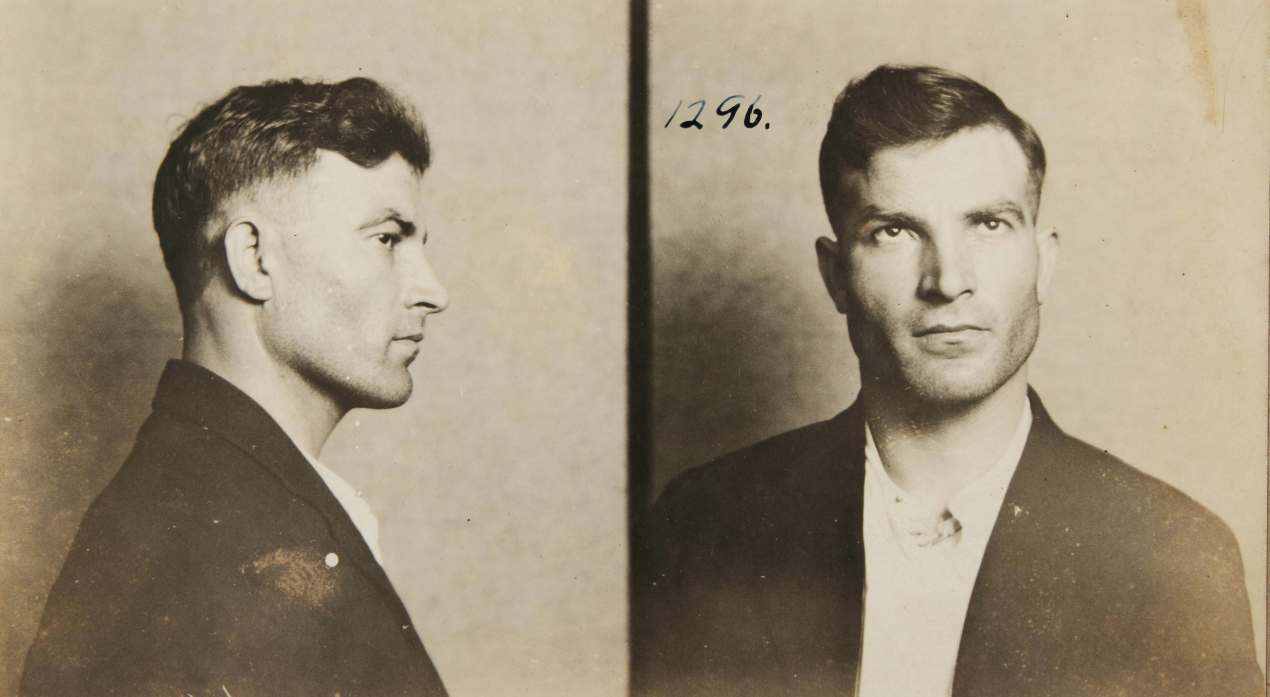
Mugshot
When you look at nineteenth-century photography, most portraits were made because somebody wanted to be remembered. People dressed in their best clothes and went to considerable trouble and expense to sit for a photograph. Sometimes it was the only photograph they would ever have taken.
A mugshot was something entirely different. You didn’t get to choose the occasion, the pose or the photographer. And you certainly weren’t getting dressed up for it. The police were interested in documenting what you looked like, not how you wanted to be remembered.
That’s one of the things I find compelling about these early photographs. Look through an old rogues’ gallery and you’ll find an extraordinary collection of faces. Some look defiant, others frightened, bored or completely indifferent. Their clothing, their expressions and the way they carry themselves tell us something about the period in which they lived.
We might know what they were accused of, but in most cases we know almost nothing else about them. And yet there they are, still looking back at us more than a hundred years later.
I wonder how many of those people ever imagined their photograph would survive so long, or that someone would be studying their face generations after they were gone.
The Coryell’s Ferry Constable’s Office
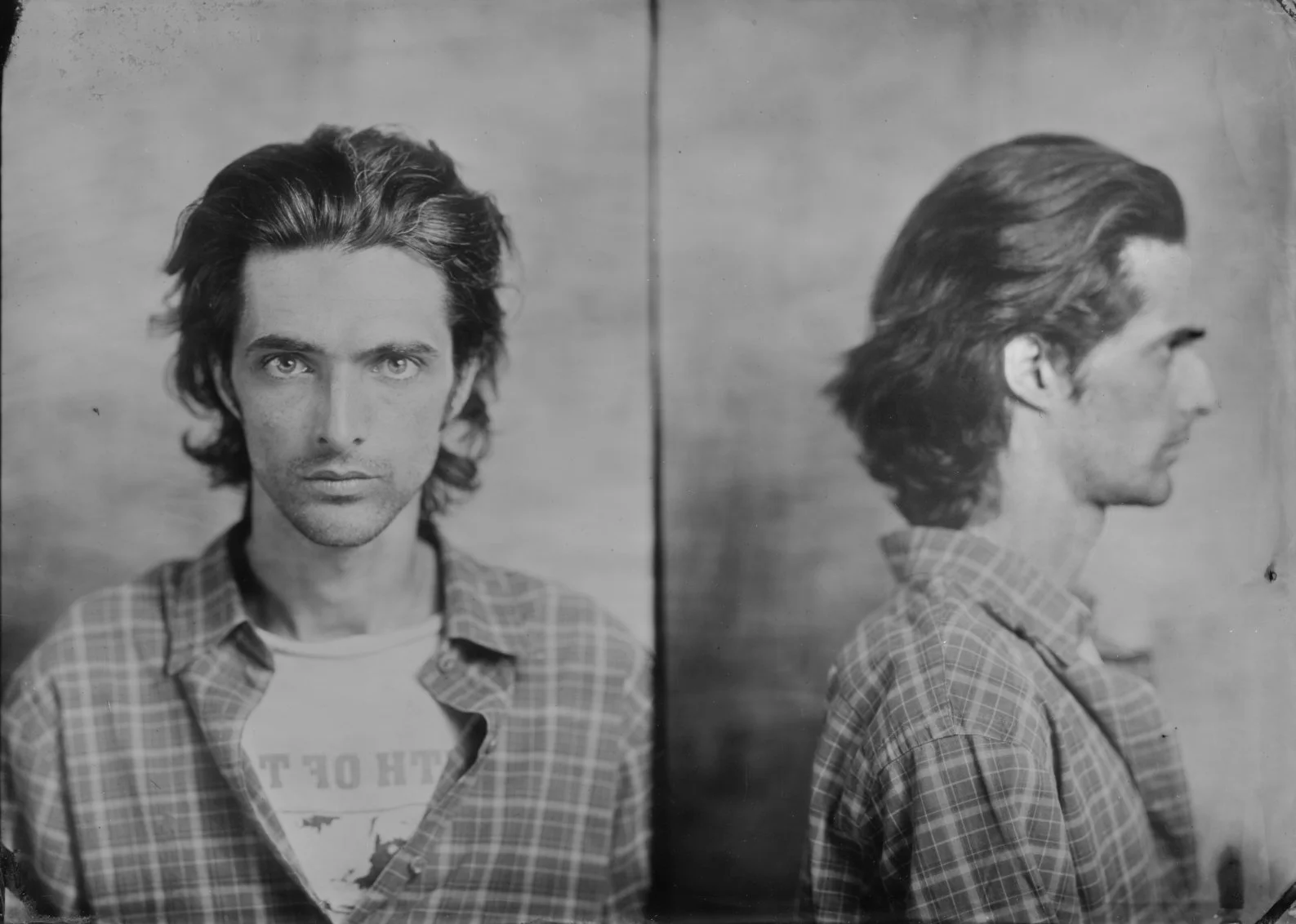
Which brings me to something I’ve been working on at the studio.
Before Lambertville was called Lambertville, the settlement was known as Coryell’s Ferry, named for the family who operated the ferry across the Delaware River. The bridge that opened in 1814 made the ferry largely obsolete.
I thought it would be amusing to resurrect a fictional version of the old constable’s office and start making mugshots using the same photographic chemistry that was around when police photography was finding its feet.
So I’ve created The Coryell Tintype Mugshot.
It’s an original 5 × 7 inch wet-plate tintype with two photographs on the same plate, one facing forward and one in profile, complete with a measuring scale behind the sitter. The plate is coated, exposed and developed by hand in my Lambertville studio.
And because a mugshot wouldn’t be much fun without a crime, everyone gets charged with something.
I’ve put together a collection of questionable nineteenth-century offenses, which are assigned entirely at random. You might find yourself charged with stealing a pie, whistling on the Sabbath or being in possession of an unruly goose.
There’s no choosing your offense. The Constable’s Office has already made its decision.
Your photograph is presented with a booking record identifying your alleged misdeeds, held together with an old-fashioned typewriter ribbon. The whole thing is intended to look as though it came out of a county records office sometime in the nineteenth century.
The sitting is $175, by appointment at my Lambertville studio, and you leave with your original tintype and booking record the same day. No digital photograph is involved, and fortunately, neither is an actual arrest.
I rather like the idea of taking a photographic process once used to document real criminals and turning it into something completely absurd.
And when I return to the old Flemington jail to make photographs, I’ll be standing in a place where the consequences of a criminal charge were considerably more serious than the theft of a pie.
The old mugshot created a permanent record of someone who had very little choice in the matter. This one gives you the opportunity to become a nineteenth-century criminal for an afternoon, without any of the unfortunate consequences.
And unlike the original subjects, you’re welcome to make an appointment.
Daniel Leocadi
Wet-Plate Collodion Photographer
Lambertville, New Jersey
