Spend enough time looking at nineteenth-century photographs and you might begin to wonder whether anybody ever had a good time. The men look stern, the women seldom appear much happier, and even the children seem to regard the whole business with suspicion. Occasionally you'll find a family portrait in which everyone appears to have fallen out with one another just before the photographer removed the lens cap.
Surely these people laughed? They told jokes and enjoyed themselves as much as anyone does today. Yet somewhere between arriving at the photographer's studio and sitting down in front of the camera, they apparently lost all desire to look cheerful.
Ask most people why nobody smiled in old photographs and you'll probably hear the same explanation. The exposures were so long that holding a smile was impossible. I've heard this countless times, and while there is some truth to it, the explanation doesn't survive much examination.
When Louis Daguerre announced his photographic process in 1839, exposure times were certainly a problem. Early photographers had to contend with relatively insensitive materials and the difficulty of keeping a person motionless. Some of the first photographic portraits were made in direct sunlight, sometimes with the sitter's eyes closed. It was hardly an enjoyable experience.
Better lenses and improvements in chemical sensitization soon shortened exposure times, sometimes bringing them under a minute in favorable conditions by the early 1840s. The familiar metal headrests found in nineteenth-century studios helped keep the sitter steady, although these devices are sometimes mistaken for evidence that every exposure took several minutes.
In 1851, Frederick Scott Archer published his wet-plate collodion process, the same method I use today. With the right lighting, a portrait could be made in a matter of seconds. It was a significant improvement in photographic quality and cost, and before long the process had become enormously popular.
I can tell you from experience that a person is perfectly capable of smiling for a wet-plate photograph. Exposure times vary depending on the light and the equipment, but there's nothing about collodion that requires a sitter to look as though they've just been sent to the gallows.
If exposure times were the principal reason people didn't smile, why do we find the same expressions in photographs taken decades after the problem had largely been overcome? The answer lies less in the camera than in what people expected a portrait to look like.
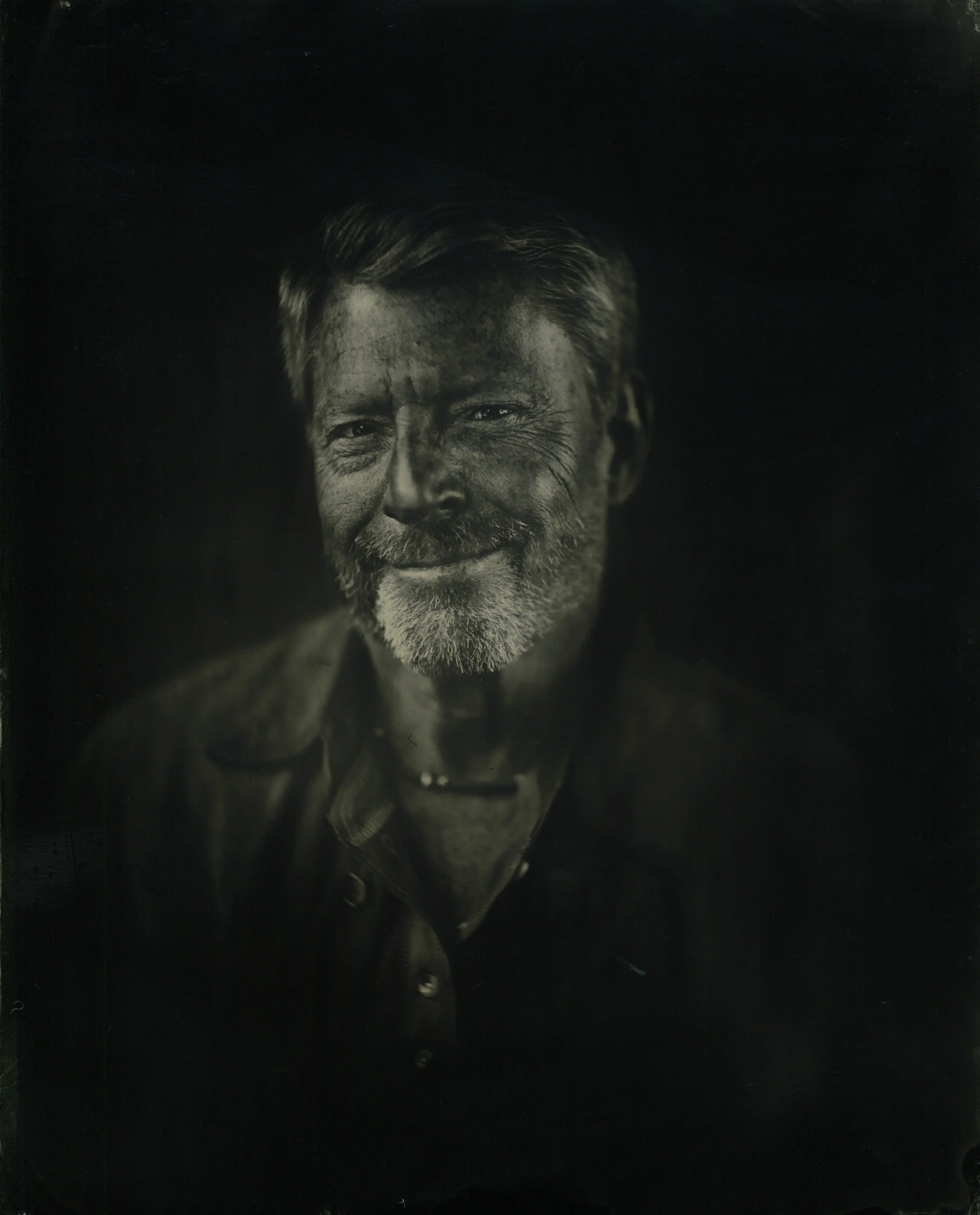
Tintype portrait made in Lambertville, NJ, using the wet plate collodion process
The Serious Business of Having Your Portrait Made
Before photography, having your portrait made was generally something reserved for people with sufficient money to commission an artist. Painted portraits were intended for display in the family home, and there were established expectations about how the sitter should appear. A respectable gentleman wasn't going to commission a portrait of himself laughing with his mouth open, any more than a wealthy woman would normally want to be remembered pulling a ridiculous face.
Have a look at the paintings hanging in almost any historical portrait gallery. The people depicted seem to share the same reluctance to smile as their photographic successors. Some look positively hostile, although I doubt that was the artist's intention.
Photography inherited these conventions. The daguerreotype offered a new way of making a portrait, but people already had an idea of what a respectable likeness should look like. They dressed appropriately and adopted an expression suitable for the occasion. Early photographers borrowed from portrait painters, arranging their sitters with the same attention to posture and appearance.
A photographic sitting was also something of an occasion. Prices gradually fell, but for many people the resulting image might be the only photographic likeness they ever possessed. They weren't there to demonstrate what a wonderful afternoon they were having. They wanted to look respectable, and nineteenth-century manners generally favored restraint over an open-mouthed grin.
Then there's the business about bad teeth. You've probably heard that Victorians avoided smiling because their teeth were rotten. Dentistry certainly had a long way to go, and tooth loss was common, but this doesn't explain why young people and children followed the same convention. Nor does it explain the surviving daguerreotypes of people grinning quite openly. Smiling was possible, both technically and socially. It simply wasn't what most people expected from a formal portrait.
Those occasional smiling portraits are among the most interesting. Remove the antique clothing and the photographic surface, and the expressions could belong to someone living today. They also remind us how little a formal photograph can reveal about someone's personality. A man who looks thoroughly miserable in an 1860s tintype might have been the funniest person in his town.
When Photography Became Less Formal
During the 1850s, photographic portraits became increasingly affordable. The ambrotype, made on glass, and the tintype, made on thin iron, brought portraiture within reach of a much larger public. Tintypes were inexpensive enough to become popular with itinerant photographers working at fairs and other public gatherings.
I have a particular affection for these old plates. Unlike daguerreotypes carefully preserved in cases, tintypes often survive loose, bent or scratched, with little information about the sitter. Some have been cut down from their original dimensions. Others still show the marks left by the photographer's chemistry.
There's an enormous variation in the quality of the work. Some were made by highly skilled photographers, while others look as though they were produced in a hurry. You can sometimes see where the collodion was unevenly poured or where the developer left its mark. These are familiar problems to anyone who works with the process today, and I enjoy seeing evidence of another photographer's hand in a plate made more than a century ago.
Despite photography becoming more affordable, the serious expression remained fashionable. The real change came when people began taking photographs themselves.
In 1888, George Eastman introduced the Kodak camera, allowing ordinary people to make photographs without knowing how to process them. The Brownie followed in 1900, making photography cheaper still. Cameras began appearing at family gatherings and on holidays, where there was little reason to follow the conventions of a formal studio portrait.
People could photograph their friends enjoying themselves instead of arranging a special sitting. The camera was becoming part of everyday life, and the expectations surrounding it changed accordingly.
Smiling became increasingly common during the early twentieth century, encouraged by amateur photography and advertising. By the middle of the century, the cheerful expression had become so familiar that people were almost expected to produce one whenever a camera appeared.
We've now reached the point where asking someone not to smile can seem like an unusual request.
Behind My Own Camera
When someone sits for a portrait in my Lambertville studio, I generally tell them to do whatever feels natural. Some people want the traditional Victorian look, complete with a stern expression, while others prefer a slight smirk. Occasionally someone arrives determined to give me the biggest smile they can manage, and that's fine too. They've come to have their portrait made, not to impersonate somebody who lived in 1860.
The difficulty is that most of us have spent our entire lives being told to smile whenever a camera appears. It's almost a reflex. Someone points a lens in our direction and we immediately arrange our face into what we think a photograph should look like. I've noticed that people sometimes hold that expression even when it doesn't seem entirely comfortable. You can see them thinking about it, trying to maintain the smile while waiting for the exposure.
One technique I use is to ask the sitter to close their eyes and then open them at the moment the flash fires. I'm interested in what happens in that brief instant, before they have time to arrange their features into something they think I want to see. I ask them to reveal themselves at that moment, rather than prepare an expression in advance.
There's no guarantee the result will be flattering, and that's not necessarily the point. Sometimes a slight smirk tells me more about the person than a broad smile ever could. Other times, the straightforward Victorian stare is exactly what suits them. I don't believe an unsmiling portrait is automatically more serious or meaningful than a cheerful one.
I can prepare the plate, arrange the lighting and focus the camera, but ultimately the person sitting in front of it has to decide what they're going to give me. The flash may freeze the exposure in a fraction of a second, but there's a difference between photographing somebody who has been holding an expression and somebody who has just opened their eyes.
Movement remains a practical concern, particularly when working with longer exposures. A sitter might hold perfectly still while I'm focusing the camera, then shift slightly during the exposure. Sometimes it's barely noticeable until the plate is developed. A face that looked perfectly focused on the ground glass suddenly appears a little soft. I've had this happen when photographing more than one person, where one sitter moves while the other remains completely still.
A natural smile can also change while you're waiting for an exposure. Someone might start with a perfectly relaxed expression, then become conscious of holding it. The smile stiffens, and what began as a cheerful expression can look uncomfortable. I suspect nineteenth-century photographers encountered the same problem, although that alone doesn't explain why so many sitters chose to look serious.
The People in the Pictures
Most surviving nineteenth-century portraits tell us very little about the people in them. Even when a name is written on the back, it rarely tells us what the person was like. We don't know whether the stern-looking gentleman was a miserable old tyrant or the sort of fellow who kept everyone entertained with terrible jokes. The woman sitting beside him might have been delighted to have her portrait made, despite looking as though she'd rather be having a tooth pulled.
Their expressions were influenced by the customs of their time, just as ours are today. The Victorian sitter usually wanted to appear dignified. We generally want to appear happy. Neither expression necessarily tells us very much about the person behind it.
When I make a portrait, I'm not concerned with whether someone smiles, smirks or looks straight into the camera without expression. I'm more interested in what happens when they stop worrying about how they're supposed to look. Sometimes that moment tells you far more than a carefully arranged smile.
So the next time you come across an old tintype showing a family who look thoroughly fed up with one another, don't feel too sorry for them. They may have had a perfectly enjoyable afternoon after leaving the photographer's studio, and I wouldn't be at all surprised if one of them complained about the way they looked in the picture.
I make tintype and ambrotype portraits at my studio in Lambertville, New Jersey, using the wet-plate collodion process introduced in 1851. Each plate is individually prepared, exposed and developed by hand.
Book a sitting
Handmade Images, 28 North Union Street, Lambertville, NJ, upstairs at the People’s Store.
